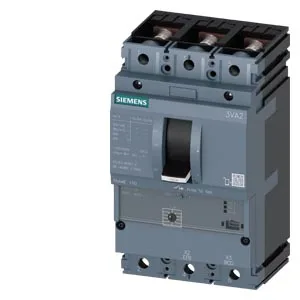
The Siemens SENTRON 3VA2163-7MS32-0DC0 is a 3-pole molded case circuit breaker rated for 63 A continuously across the full ambient range from 40 °C to 70 °C — no derating needed up to that temperature. That 63 A frame is sized for motor or feeder circuits where the load current stays below the threshold, and the interrupting ratings tell you where it can safely clear a fault: 330 kA at 240 V AC, 242 kA at 415 V and 440 V, 187 kA at 500 V, and 3.7 kA at 690 V. The design is explicitly for starter protection, meaning it's intended to sit ahead of a motor starter — not as a main feeder breaker, but as the branch-circuit protection for a motor load. That's a common requirement for safety circuits in conveyor or pump applications.
The 105 mm width matches the SENTRON 3VA frame, so it fits in a standard distribution panel alongside other 3VA breakers. The undervoltage release is wired separately — verify the control voltage matches your system before energizing. The two HQ auxiliary switches provide independent N/O and N/C contacts; wire them back to the PLC input module for status monitoring. Maximum power loss is 6.5 W — negligible for thermal management in a panel, but good to know for energy budgeting.