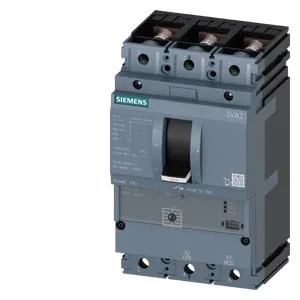
Siemens 3VA2163-7MS32-0JA0 — 63 A SENTRON MCCB with ETU310M, Starter Protection
The Siemens 3VA2163-7MS32-0JA0 is a 3-pole SENTRON molded case circuit breaker (MCCB) rated for 63 A continuous current at 40 °C, with an ETU310M electronic overcurrent release and a built-in shunt trip (STL) for remote tripping. It carries a breaking capacity of 330 kA at 240 V, 242 kA at 415 V, and 52.5 kA at 690 V — numbers that matter when you are protecting a motor branch circuit against high-fault utility feeds or large transformer secondaries. The starter protection designation means the trip curve is shaped to coordinate with contactor and overload relay in a motor starter combination, not a generic distribution feeder.
Rated continuous current Iu is 63 A across the ambient range from 40 °C to 50 °C, then derates to 60.48 A at 55 °C and 56.7 A at 70 °C (–). The ETU310M release provides adjustable thermal-magnetic or electronic trip characteristics depending on the exact firmware variant — this one is the starter protection version, so the long-time and short-time pickup are preset to coordinate with motor-starting inrush without nuisance tripping. The shunt trip (STL) allows a remote pushbutton or PLC output to open the breaker instantly, which is standard for emergency-stop circuits that need to kill motor power without pulling the handle.
No auxiliary contacts are included, but the shunt trip (STL) is integrated, so you do not need a separate undervoltage release module for remote tripping.