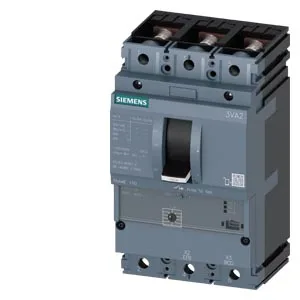
The adjustable trip range spans 189 A to 945 A, so you set the magnetic pickup to match the motor's inrush without nuisance tripping. Interrupting capacity is voltage-dependent: 330 kA at 240 V, 242 kA at 415 V and 440 V, 187 kA at 500 V, and 3.7 kA at 690 V.
Built-in accessories and wiring
That means you can remotely trip the breaker via a control signal — useful for emergency-stop circuits or PLC-based shutdown sequences — and get status feedback (open/closed/tripped) back to the controller. The basic switch assembly is order code 3VA2163-7MS32-0AA0, which is the interchangeable switching mechanism inside the molded case. If the switch mechanism fails but the case and terminals are intact, you can swap that subassembly rather than replace the whole breaker.
The 63 A continuous rating at 70 °C ambient is the number that governs real-world panel loading. Many breakers derate above 40 °C; this one holds full rating through 70 °C, so you can pack it into a hot enclosure without oversizing the frame. The 189-945 A adjustable magnetic trip range lets you dial the instantaneous pickup to just above the motor's locked-rotor current — typically 6-8x FLA for a standard induction motor — so the breaker clears a bolted fault without tripping on startup inrush. The shunt trip coil draw is not listed here, but typical STL coils pull about 10-20 VA during the trip pulse; factor that into your control transformer sizing.