At 240 V it's even higher at 187 kA, and even at 500 V it still holds 75.6 kA. Only at 690 V does it drop to 4.5 kA, so if your line runs 690 V, this isn't the breaker for that bus.
Motor protection specifics
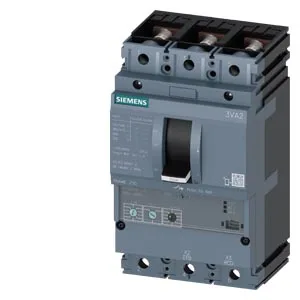
This MCCB is explicitly designed for motor protection, which means it includes phase failure detection and is set up for an undervoltage release (UVR) — the auxiliary release type is an undervoltage release. That UVR lets you tie the breaker into a safety circuit or E-stop chain: if control voltage drops, the breaker trips. No ground-fault monitoring module is fitted, so if you need GF protection, plan on an external relay or a different variant. There's no trip indicator on this unit, so when it trips you won't get a local flag — you'll need to check the breaker position or wire an auxiliary contact into your PLC. The basic switch variant is 3VA2216-5MN32-0AA0, which is the same breaker without the UVR; this -0CA0 suffix adds the undervoltage release.
The 3VA2216-5MN32-0CA0 measures 181 mm high by 105 mm wide by 86 mm deep. Power loss is listed at a maximum of 22.2 W. In a sealed panel with multiple breakers running near full load, that adds up — plan for forced airflow or a larger enclosure to stay under the 70 °C max operating temperature.