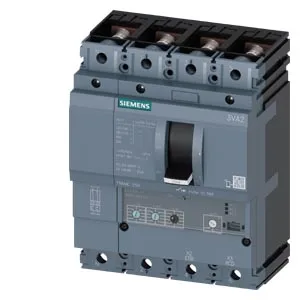
The Siemens SENTRON 3VA2225-5HL42-0CC0 is a 4-pole molded case circuit breaker rated for 250 A continuous at 40 °C, with a maximum breaking capacity of 187 kA at 240 V. It's designed for line protection in distribution panels, and it carries an undervoltage release as standard — so if you lose control voltage, the breaker trips without waiting for a fault. At 250 A continuous, this breaker handles the main feed for a moderate industrial subpanel or a large motor control center feeder. The 4-pole configuration covers three-phase plus neutral, common in North American and IEC distribution. The 187 kA interrupting rating at 240 V gives serious headroom for high-fault locations like transformer secondaries or generator paralleling gear.
Panel fit and dimensions
The 3VA2225-5HL42-0CC0 measures 86 mm deep, 140 mm wide, and 181 mm tall. That 140 mm width is a standard 4-pole MCCB footprint — it drops into most SENTRON panelboards and switchboards without re-drilling the mounting plate. The 86 mm depth leaves room behind the door for wiring gutters and auxiliary contact access.
Breaking capacity across voltages
This breaker's interrupting performance is rated per voltage: 187 kA at 240 V, 121 kA at 415 V and 440 V, 75.6 kA at 500 V, and 4.5 kA at 690 V. The steep drop at 690 V is typical for a 250 A frame — at that voltage you're on the edge of the design. For most 480 V or 400 V industrial services, the 121 kA rating is more than enough for a main breaker position.
Thermal derating and operating range
The breaker holds its full 250 A rating from 40 °C up to 50 °C. At 55 °C it derates to 241 A, at 60 °C to 232 A, and at 65 °C to 222 A, hitting 213 A at 70 °C. If your panel ambient runs hot — say near a furnace or in a non-conditioned electrical room — plan for that derating. The operating temperature range is -25 °C to 70 °C, with storage from -40 °C to 80 °C.
Auxiliary and undervoltage release
Factory-fitted with two HQ auxiliary switches and an undervoltage release (UVR). The UVR trips the breaker when control voltage drops below a threshold — a standard feature for emergency-stop circuits or undervoltage protection on motor feeds. The two auxiliary switches give you status feedback for the PLC or remote monitoring.
