Breaking capacity — the so-what
At 240 V it interrupts 187 kA — that's utility-grade fault current, typical for large transformer secondaries or industrial switchboards. At 415 V and 440 V it holds 121 kA; at 500 V it drops to 75.6 kA; at 690 V it's 4.5 kA. The high-voltage drop tells you this is a low-voltage MCCB optimised for 480 V class systems — at 690 V the arc extinction runs out of steam, so don't spec it on a 690 V bus expecting the full rating.
Thermal derating — the number that changes with your panel temp
Rated 250 A continuous at 40 °C, 45 °C, and 50 °C — no derating needed up to 50 °C. At 55 °C it drops to 241 A, at 60 °C to 232 A, at 65 °C to 222 A, and at 70 °C to 213 A.
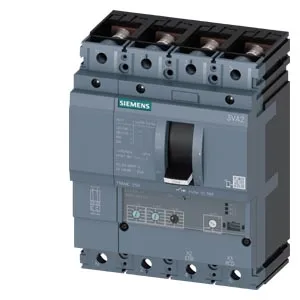
Four-pole means it occupies the full width; no single-pole modular stacking. The shunt trip coil draws power continuously when the breaker is closed; verify the control circuit can supply the holding current without overheating the coil. No communication function, no trip indicator — this is a bare electromechanical MCCB, not a smart breaker.