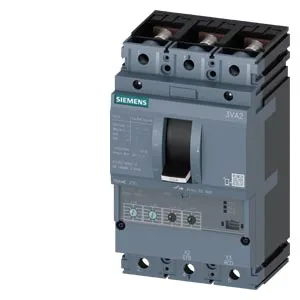
The Siemens 3VA2225-5HN32-0BH0 is a SENTRON molded case circuit breaker (MCCB) rated for 250 A continuous current (Iu) across three poles, with an ETU350 electronic trip unit configured for line protection. Its interrupting capacity reaches 187 kA at 240 V and 121 kA at 415 V, which means it can clear high-fault currents in a main distribution panel without upstream fuses needing to open first — a key selectivity consideration for the site electrical engineer. Dimensions are 86 mm deep, 105 mm wide, and 181 mm tall — a standard 3-pole MCCB footprint that fits Siemens SENTRON mounting plates and most DIN-rail adapter kits. The operating temperature range is -25 °C to 70 °C, with storage from -40 °C to 80 °C, so it handles unheated warehouses or outdoor enclosures as long as the ambient inside the panel stays within the derating curve.
Derating and thermal management
At 40 °C, 45 °C, and 50 °C the breaker holds the full 250 A rating. At 55 °C it derates to 241 A, at 60 °C to 232 A, at 65 °C to 222 A, and at 70 °C to 213 A. Maximum power loss is 50.5 W — enough heat that the panel OEM should account for it in the thermal budget, especially when multiple breakers are ganged in a row without ventilation gaps.
Interrupting ratings across voltages
The breaker's interrupting capacity (Icu) varies with system voltage: 187 kA at 240 V, 121 kA at both 415 V and 440 V, 79 kA at 500 V, and 5.1 kA at 690 V. The steep drop at 690 V means this is primarily a 480 V class device; for 690 V applications the available fault current must be verified against the 5.1 kA limit.