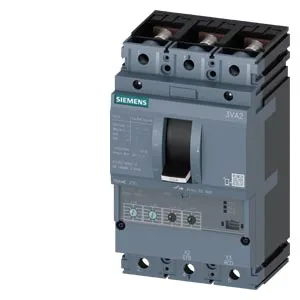
What this MCCB delivers — and where the ratings matter
The Siemens SENTRON 3VA2225-5HN32-0BL0 is a 3-pole molded case circuit breaker (MCCB) rated for line protection at 250 A continuous current. The interrupting capacity tells the real story: 187 kA at 240 V, 121 kA at 415 V and 440 V, 79 kA at 500 V, and 5.1 kA at 690 V. That 187 kA figure at 240 V means it can clear a massive fault without the arc flashing over — essential for high-fault panels fed close to a transformer. The 121 kA at 415 V covers the common industrial distribution voltage in most of the world; the drop to 5.1 kA at 690 V is still respectable for a 250 A frame at that voltage class. Thermal derating is published across the operating range: full 250 A up to 50 °C, then 241 A at 55 °C, 232 A at 60 °C, 222 A at 65 °C, and 213 A at 70 °C. If your panel ambient runs hot — say, a non-ventilated enclosure near a furnace line — the 60 °C derating to 232 A is the number to size against, not the 250 A nameplate. The ETU350 electronic trip unit handles the curve shaping, and the built-in undervoltage release (UVR) drops the breaker on loss of control voltage, which is standard for safety circuits that need a guaranteed disconnect on power loss.
Panel fit and integration
Dimensions: 105 mm wide, 181 mm high, 86 mm deep. That 105 mm width is a standard 3-pole MCCB footprint for the 250 A frame class — it'll drop into the same mounting holes as other SENTRON 3VA breakers of this rating. The 86 mm depth leaves room for rear bus connections or plug-in bases in a typical distribution panel. Rated insulation voltage is 800 V, so it's fine for 690 V systems with margin. Maximum power loss is 50.5 W — account for that heat in your enclosure thermal calculation, especially if you're stacking multiple breakers in a row.
Selectivity and coordination note
With 20 000 mechanical/electrical endurance cycles, this is a distribution breaker, not a switching device for frequent motor starts — it's designed to sit closed and clear faults, not cycle daily. The ETU350 release gives you LSI (long-time, short-time, instantaneous) protection curves, which lets you coordinate downstream with smaller MCCBs or fuses. The trip indicator gives a visual flag on the front, so a maintenance walk-through catches a tripped breaker without opening the panel door.
