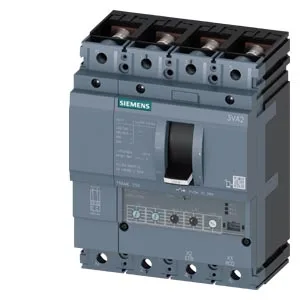
The SENTRON 3VA2225-5HN42-0CL0 is a 4-pole molded case circuit breaker (MCCB) rated for 250 A continuous current across the 40 °C to 50 °C ambient range — no derating needed in a typical warm panel. The interrupting ratings tell you where this breaker can live on the fault-current map: 187 kA at 240 V, 121 kA at 415 V and 440 V, 75.6 kA at 500 V, and 4.5 kA at 690 V. At 240 V, that 187 kA is high enough for most service-entrance or transformer-fed main breakers in North American panels. Above 50 °C the breaker starts to thermally derate: 241 A at 55 °C, 232 A at 60 °C, 222 A at 65 °C, 213 A at 70 °C. If your panel ambient runs over 50 °C, factor that curve into the load calculation.
The 250 A continuous rating is the breaker's thermal-magnetic or electronic trip threshold — it's sized for a feeder or main that carries up to 250 A of load current continuously. That's standard for TN-S or TN-C-S systems where the neutral needs to be switched and protected. That gives you remote status indication: breaker on/off, trip event, and a separate alarm contact. The trip indicator on the front confirms the breaker opened on a fault vs. manual operation.
The footprint is 86 mm deep, 140 mm wide, 181 mm tall — a compact 4-pole frame for the 250 A rating. In a typical distribution panel, it occupies the main breaker position with bus bars feeding downstream branch breakers. Maximum power loss is 50.5 W at rated current. That heat has to be vented out of the enclosure — factor it into the panel cooling calculation, especially in a sealed cabinet. The storage limits govern handling and warehousing, not running conditions.
The base switch (the core breaker without accessories) is order code 3VA2225-5HN42-0AA0. The -0CL0 suffix indicates the factory-fitted undervoltage release and the auxiliary/alarm switch configuration. If you need to replace just the internal switch or verify compatibility with an existing panel, that's the reference.