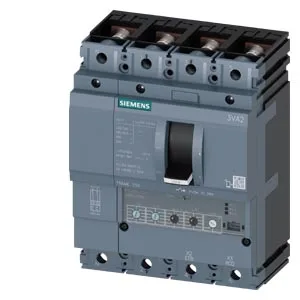
What this MCCB carries — and what it means for your panel
The Siemens SENTRON 3VA2225-5HN42-0DC0 is a 4-pole molded case circuit breaker (MCCB) rated for 250 A continuous current (Iu) at 40 °C, with an ETU350 electronic trip unit. That interrupting capacity at 240 V — 187 kA — means it can clear a bolted fault on a high-capacity transformer secondary without the arc flashing over to adjacent gear. At 415 V it still holds 121 kA, so it's comfortable on 400 V distribution in industrial plants where fault currents run hot. The ETU350 release gives you adjustable long-time, short-time, and instantaneous pickup, plus ground-fault capability if the system needs it. That matters when you're coordinating downstream feeders — you can shape the trip curve to ride through motor inrush and still catch a hard fault fast. No communication module on this variant, so it's a standalone thermal-magnetic replacement with electronic precision.
Lifecycle and sourcing posture
The auxiliary contact version ships with 2 auxiliary switches (HQ type), and the undervoltage release (UVR) is integrated — no separate add-on module to order. That simplifies the BOM and the panel wiring: one line item covers the breaker and its shunt-trip function for safety circuits.
Integration into the panel — dimensions and mounting
At 140 mm wide, 181 mm tall, and 86 mm deep, this MCCB fits standard SENTRON mounting footprints. It's a fixed-mount design — no draw-out cradle — so plan for bolted bus connections in the distribution section. The depth leaves room for rear cable access in a 400 mm deep enclosure. Rated insulation voltage Ui is 800 V, so it's fine on 690 V systems where the line-to-line voltage stays under that ceiling. The 50.5 W maximum power loss at full load means the enclosure needs some ventilation if you're packing multiple breakers in a row — derating starts at 55 °C, where the continuous current drops to 241 A.
What the ratings mean for selectivity and coordination
The interrupting curve is steep: 187 kA at 240 V, 121 kA at 415 V, 79 kA at 500 V, and 5.1 kA at 690 V. That tells you the arc extinction relies on voltage-dependent chamber design — at 690 V you need upstream current-limiting fuses or a higher-rated breaker if the available fault current exceeds 5.1 kA. For typical 480 V distribution in North America, 79 kA covers most industrial service entrances. Latching endurance is rated at 20,000 operations — that's the mechanical life for the switching mechanism, not the electrical endurance under load. For a line-up MCCB that gets cycled maybe a few times a year for maintenance isolation, that's effectively unlimited. The trip indicator is not fitted on this variant, so you'll need the auxiliary contacts or a visual check to confirm tripped status.
