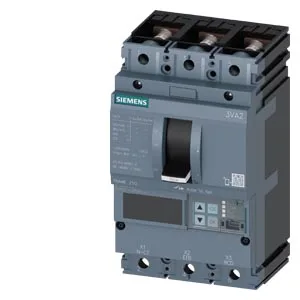
What this MCCB carries and where it fits
The Siemens 3VA2225-5KP32-0BL0 is a SENTRON molded case circuit breaker rated for 250 A continuous current at 40 °C, holding that rating flat through 50 °C before derating to 238 A at 55 °C and 200 A at 70 °C. That derating curve means you can push the full 250 A in a warm panel up to 50 °C — above that, you lose about 2.4 A per degree, which matters when sizing for a crowded enclosure with limited airflow. Breaking capacity runs 187 kA at 240 V, 121 kA at 415 V and 440 V, 75.6 kA at 500 V, and 4.5 kA at 690 V. The 187 kA at 240 V covers high-fault utility feeds; the 121 kA at 415 V handles most European industrial distribution. At 690 V the 4.5 kA figure is lower — this breaker is not your first pick for 690 V high-fault applications, but it still clears moderate faults at that voltage. Three-pole design, line-protection profile, with an undervoltage release (UVR) and a communication function built in. The auxiliary switch complement is 2 auxiliary switches + 1 trip alarm switch + 1 electrical alarm switch HQ. No ground-fault monitoring version here — that's a separate variant if you need GFCI.
Panel fit and integration notes
Dimensions: 105 mm wide, 181 mm high, 86 mm deep. That 105 mm width is the standard 3-pole MCCB footprint for this SENTRON frame size. Power loss is 50.5 W maximum at rated load. That's the heat you need to vent in the enclosure — at 250 A continuous, that much dissipation can raise internal temperature by several degrees, so factor it into your thermal budget if the panel is sealed or tightly packed. Operating temperature range -25 °C to 70 °C; storage from -40 °C to 80 °C. The storage range covers cold warehouses and hot shipping containers; the operating range suits most indoor industrial environments, including unheated plant floors in winter.
What the basic switch and releases tell you
The supplied basic switch is order code 3VA2225-5KP32-0AA0 — that's the core switching mechanism this breaker is built around. The undervoltage release (UVR) trips the breaker when supply voltage drops below a threshold, protecting motors and other loads from running on undervoltage. Trip indicator is present, so you get a visual flag on the breaker face after a fault. Communication function and 'other measurement function' are listed — this variant supports remote monitoring or control integration, though the exact protocol (PROFIBUS, PROFINET, Modbus) isn't specified here. If you need that detail, the full datasheet covers the communication module options.
