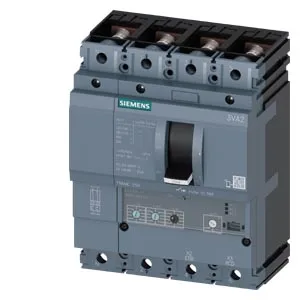
Above 50 °C the allowable current steps down: 241 A at 55 °C, 232 A at 60 °C, 222 A at 65 °C, and 213 A at 70 °C. For a panel that runs warm — say a packed enclosure with multiple breakers — the 55 °C figure is the practical design point; the 213 A floor at 70 °C is the absolute limit before the trip unit's thermal memory starts to nuisance-trip on a load that's within the breaker's nameplate. Maximum power loss is 48 W, which factors into the enclosure's thermal budget.
Interrupting Capacity by Voltage
The interrupting capacity varies with system voltage: 242 kA at 240 V, 187 kA at 415 V and 440 V, 121 kA at 500 V, and 4.5 kA at 690 V. The steep drop at 690 V is characteristic of a breaker whose arc-chamber and contact geometry are optimized for the 240–500 V range — at 690 V the available fault current must be limited to 4.5 kA, which typically restricts this frame to 480 V or 600 V class systems in practice.