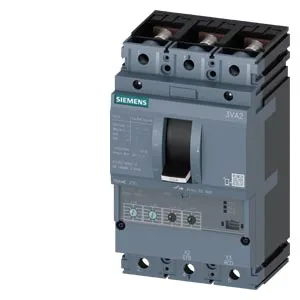
What this MCCB carries and where it fits
The Siemens 3VA2225-7HN32-0JA0 is a SENTRON molded case circuit breaker (MCCB) rated for 250 A continuous current, with a 3-pole configuration and a shunt trip (STL) auxiliary release built in. It is designed for line protection duty — meaning it protects feeders and distribution branches, not motor loads directly. The interrupting capacity hits 330 kA at 240 VAC and 242 kA at 415 VAC, so it handles high-fault-current points like main switchboards or large distribution panels. The shunt trip release lets you remotely trip the breaker via a control voltage signal — useful for emergency-stop circuits or interlocking with fire-alarm systems where you need to kill power without walking to the panel. No undervoltage release is fitted on this variant, so the breaker stays latched unless the shunt trip is deliberately energized.
Thermal derating and real-world current
The 250 A rating holds from 40 °C through 50 °C ambient. Above that it derates: 241 A at 55 °C, 232 A at 60 °C, 222 A at 65 °C, and 213 A at 70 °C. If your panel runs hot — near a furnace line or in a sealed enclosure with other heat sources — the 70 °C figure is the one to use for sizing. Power loss at full load is 48 W maximum, which matters for enclosure thermal calculations.
Panel fit and dimensions
Mounts in a standard MCCB footprint: 105 mm wide, 181 mm tall, 86 mm deep. Three-pole form factor fits Siemens SENTRON panelboards and most DIN-rail adapter plates for third-party enclosures. The 86 mm depth is the body only — allow clearance for the shunt trip wiring and any rear-connection lugs.
Selectivity and coordination note
With 330 kA at 240 V and 242 kA at 415 V, this breaker can be the main in a fully rated system without cascading upstream. For selective coordination downstream, pair it with SENTRON 3VA1 or 3VA2 series breakers rated below 250 A — the manufacturer's selectivity tables (available in the SENTRON planning guide) give the maximum let-through for each combination. The line-protection design curve (not motor-protection) means it trips faster on short-circuit than a motor-circuit protector would, which improves coordination with downstream feeders.
