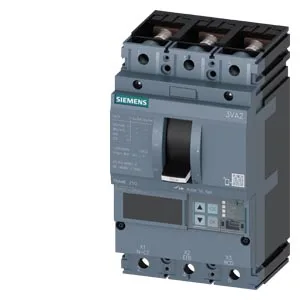
Siemens 3VA2225-7KP32-0HH0 — SENTRON MCCB for Line Protection
It carries a rated continuous current of 250 A at 40 °C and holds that rating through 50 °C, then derates linearly to 200 A at 70 °C — the thermal curve matters if your panel runs hot or you're pushing the bus toward the upper ambient. The adjustable thermal-magnetic trip unit covers 375 A to 2500 A, so you set the actual protection point in the field, not at the factory. Interrupting capacity is 330 kA at 240 V, 242 kA at 415 V and 440 V, 187 kA at 500 V, and 4.5 kA at 690 V. The 3-pole construction is standard for three-phase line protection.
Built-in Indication and Auxiliary Hardware
The breaker ships with a trip indicator, a voltage trigger, and a communication function plus an additional measurement function. That means the panel builder can wire the STL into an emergency-stop chain or a PLC-driven shutdown circuit without drilling into the breaker cover. That 105 mm width per 3-pole MCCB is standard for the SENTRON 3VA frame size — it fits the same mounting hole pattern as other breakers in the series, so a panel already laid out for a 3VA22 frame accepts this unit without re-drilling.