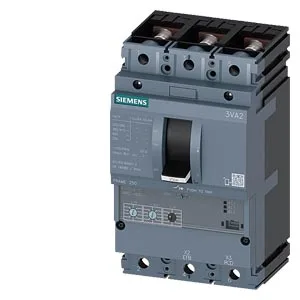
The 3VA2225-8HL32-0AG0: The interrupting capacity is the headline number here: 440 kA at 240 V AC, 330 kA at 415 V and 440 V, 220 kA at 500 V, and 52.5 kA at 690 V. That's a serious SCCR for a 250 A frame — it means this breaker can safely clear a fault up to those levels without cascading upstream, which is what you need when you're coordinating a main or feeder in a high-fault installation. The 3VA2 series uses the same platform as the 3VA1 but with a higher interrupting rating, so if you're upgrading from a 3VA1 that couldn't hold the fault current, this is the direct path.
Thermal derating and panel fit
The breaker holds its full 250 A rating up to 50 °C ambient. Above that it derates linearly: 241 A at 55 °C, 232 A at 60 °C, 222 A at 65 °C, and 213 A at 70 °C. If your panel runs hot — say a packed enclosure with drives and transformers — you need to account for that derating at the design stage, not after commissioning. The maximum operating temperature is 70 °C, storage from -40 °C to 80 °C. Dimensions are 181 mm high, 105 mm wide, 86 mm deep. That's a standard 3-pole MCCB footprint for the 250 A frame class — it will drop into a panel that was laid out for a 3VA2 or similar SENTRON frame without re-drilling the mounting plate. The auxiliary switch configuration is 1 auxiliary switch plus 1 trip alarm switch (HP type), which gives you a remote status signal without needing an external relay.
Sourcing and lifecycle
Power loss at full load is 48 W maximum — that's the heat you need to vent from the enclosure. The breaker has a trip indicator (mechanical flag) but no undervoltage release, no communication module, and no ground-fault monitoring built in. It's a straight line-protection device; if you need those functions, you add them externally or step up to a 3VA2 variant with the options factory-installed.
