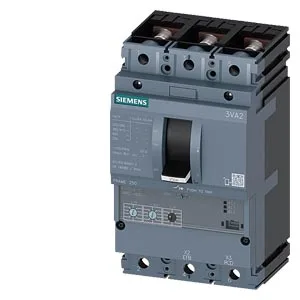
What this MCCB carries — and what it means for your panel
The SENTRON 3VA2225-8HL32-0BH0 is a 3-pole molded case circuit breaker rated for 250 A continuous current at 40 °C, with a line-protection design that includes an undervoltage release (UVR) and a complement of 2 auxiliary switches plus 1 trip alarm switch (HQ). Its interrupting capacity is the headline: 440 kA at 240 V, 330 kA at 415 V and 440 V, 220 kA at 500 V, and 52.5 kA at 690 V — numbers that put it in the high-fault tier for industrial distribution, not a general-purpose branch breaker. At those SCCR levels, this breaker is sized for transformer secondaries, large motor control centers, or main feeders where available fault current is substantial — the 440 kA at 240 V tells you it can sit downstream of a big pad-mount transformer without needing a current-limiting fuse upstream. The thermal derating curve is published: it holds 250 A flat through 50 °C, then steps down to 241 A at 55 °C, 232 A at 60 °C, 222 A at 65 °C, and 213 A at 70 °C. If your enclosure hits 55 °C internal ambient, you lose 9 A — plan the load margin accordingly. Dimensions are 105 mm wide, 181 mm high, 86 mm deep — a standard 3-pole MCCB footprint that fits most DIN-rail or panel-mount enclosures without a re-drill.
Auxiliary and release configuration
The breaker ships with an undervoltage release (UVR) integrated — that's the '0BH0' suffix's main story: it drops the breaker when control voltage falls below the dropout threshold, which is standard for safety circuits that need a loss-of-voltage trip. The auxiliary switch complement is 2 form-C contacts plus 1 trip alarm switch (HQ), giving you remote status on the breaker position and a dedicated signal for fault-trip events — enough for a PLC input card without external interposing relays. The basic switch assembly is order code 3VA2225-8HL32-0AA0, meaning the '0BH0' variant adds the UVR and the specific aux-switch configuration on top of that base platform.
