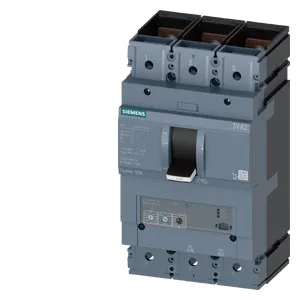
What this 3VA2450-5MN32-0KA0 is and what it does
The Siemens 3VA2450-5MN32-0KA0 is a SENTRON series molded case circuit breaker (MCCB) designed specifically for motor protection. It's a 3-pole unit rated at 500 A at 40 °C, with a shunt trip release (STL) for remote tripping. This is the variant with the basic switch 3VA2450-5MN32-0AA0 inside, no auxiliary switch, and no communication module — a straightforward, hardwired motor protection breaker for a panel.
Rated current and thermal derating
The breaker holds its full 500 A rating from 40 °C up through 50 °C ambient. Above that, it derates: 495 A at 55 °C, 490 A at 60 °C, 485 A at 65 °C, and 480 A at 70 °C. If your panel ambient runs hot — say, a crowded enclosure near a motor — that 480 A at 70 °C is the number to size against, not the nameplate 500 A. The maximum operating temperature is 70 °C; storage range is -40 °C to 80 °C.
Breaking capacity across voltages
This MCCB's interrupting rating varies significantly with system voltage. At 240 V it's rated for 187 kA; at 415 V and 440 V it's 121 kA; at 500 V it drops to 75.6 kA; at 690 V it's 9 kA. That 9 kA at 690 V is the weak point — if your motor circuit runs at 690 V, verify the available fault current stays under that. The breaker also carries a 6 kA rating limited to 1 second, likely for short-time withstand during selective coordination studies.
Physical fit and panel integration
Dimensions are 248 mm high, 138 mm wide, 110 mm deep. That's a standard 3-pole MCCB footprint for this current class — it'll drop into a SENTRON 3VA2 mounting base or panel-mount kit without surprises. The 99 W maximum power loss at rated load needs to be factored into your enclosure thermal calculation; that's heat that has to leave the cabinet.
Protection features and trip characteristics
Designed for motor protection, this breaker includes phase failure detection — a critical feature for three-phase motor loads where a lost phase can burn out a winding. The trip unit has a voltage trigger (undervoltage release is not fitted on this variant; the shunt trip is the only auxiliary release). Trip indicator is not present, so you won't get a visual flag on the breaker face after a trip — plan for remote indication via the shunt trip circuit or a separate auxiliary contact block.
