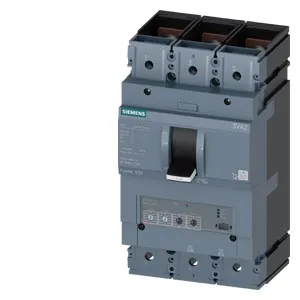
What this 630 A MCCB carries — and what it doesn't
The Siemens SENTRON 3VA2463-5HN32-0KL0 is a 3-pole molded case circuit breaker rated for 630 A continuous current at 40 °C, with a line protection design — meaning it's built to protect feeders and main distribution, not motor branch circuits. The interrupting capacity hits 187 kA at 240 V, drops to 121 kA at 415 V and 440 V, 75.6 kA at 500 V, and 9 kA at 690 V. That 187 kA figure at 240 V puts it in the high-interrupting class for large service entrances or transformer secondaries where fault current runs high. The breaker includes a shunt trip release (STL) and a complement of auxiliary switches: 2 auxiliary switches, 1 trip alarm switch, and 1 electrical alarm switch HQ. No undervoltage release, no ground-fault monitoring, no communication function — this is a straightforward line-protection device with remote trip capability and status feedback, not a smart breaker.
Derating and panel fit — the numbers that matter for a 630 A breaker
The 630 A rating is at 40 °C ambient. At 45 °C it derates to 612 A, at 50 °C to 593 A, at 55 °C to 575 A, at 60 °C to 557 A, at 65 °C to 538 A, and at 70 °C to 520 A. If your panel runs hot — say 50 °C inside a packed enclosure — you're losing roughly 6% of capacity. Plan the load accordingly. Dimensions: 248 mm high, 138 mm wide, 110 mm deep. That 138 mm width across three poles is standard for a 630 A frame. Max power loss is 162 W. That's heat that stays inside the enclosure — factor it into your thermal calculation if the panel is sealed or has limited ventilation. Operating temperature range is -25 °C to 70 °C; storage range is -40 °C to 80 °C. The storage limits are wider because the breaker isn't carrying current — that's the handling spec, not the running spec.
What the auxiliary switch complement means for your control wiring
The breaker ships with 2 auxiliary switches (form C, normally open/normally closed), 1 trip alarm switch (signals that the breaker tripped on fault, not manual open), and 1 electrical alarm switch HQ (high-quality, typically used for remote annunciation in critical circuits). That's four separate signal paths — enough for a PLC input, a status lamp, a remote SCADA point, and a spare. The shunt trip (STL) allows remote tripping by applying a control voltage. No undervoltage release is fitted, so the breaker won't automatically open on loss of control power — that's a deliberate choice for applications where you want the load to stay online even if the control supply drops. Trip indicator is present — a mechanical flag visible on the front of the breaker shows whether it tripped on fault or was manually switched off. Helps the maintenance tech distinguish a real event from a test or isolation.
