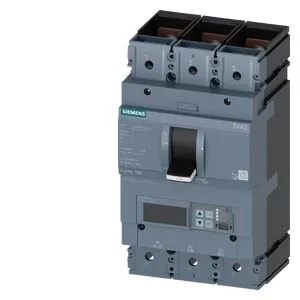
The 3VA2463-6JP32-0BL0: This breaker is rated for 242 kA at 240 V, 187 kA at 415 V and 440 V, 121 kA at 500 V, and 9 kA at 690 V. At 690 V the 9 kA rating is the limiting case; if your system fault level exceeds that, this breaker isn't your pick for that voltage tier.
The 630 A continuous rating is at 40 °C ambient. In a hot panel — say 50 °C — it's good for 570 A; at 60 °C you're down to 510 A; at 70 °C it's 450 A. That's a 180 A drop from the base rating. If you're cramming this into a tight enclosure next to drives or transformers, size the load for the derated number, not the catalog headline.
The UVR drops the breaker on voltage sag below the dropout threshold — useful for motor protection or emergency-stop chains where you want the load disconnected when control power fails. Communication function is onboard, so it can talk to a BMS or PLC for remote trip indication and load monitoring.
The 110 mm depth leaves room for rear bus connections in a standard 600 mm deep enclosure. Max power loss is 164.5 W at full load; factor that into your panel thermal budget if you're stacking multiple breakers.