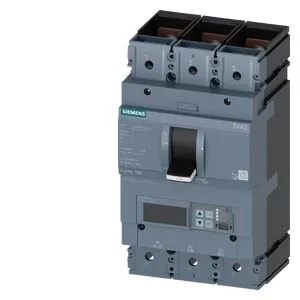
The continuous current derates as ambient rises: 600 A at 45 °C, 570 A at 50 °C, 540 A at 55 °C, 510 A at 60 °C, 480 A at 65 °C, and 450 A at 70 °C — so the real-world ampacity depends on your panel's internal temperature, not just the nameplate 630 A. Breaking capacity is where this frame earns its keep: 242 kA at 240 V, 187 kA at 415 V and 440 V, 121 kA at 500 V, and 9 kA at 690 V. The adjustable trip unit spans a minimum of 945 A to a maximum of 5 670 A, giving you the range to tune the magnetic pickup to the downstream load's inrush profile. The breaker includes a communication function, meaning it can report status and trip events over a bus — useful for a BMS or SCADA system that needs to know which feeder opened without a physical walk-down.
The basic switch variant is 3VA2463-6JP32-0AA0 — the -0CC0 suffix adds the communication module and the UVR. If your BOM was written around the -0AA0, the -0CC0 drops into the same physical cutout and bus connection; the only difference is the control wiring for the UVR and the comms cable.
Maximum power loss is 164.5 W at rated load — factor that into your panel's thermal budget.