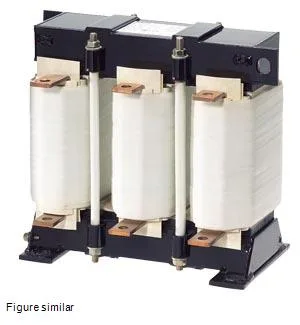
The Siemens 4EU3921-6EA00-0A is a three-phase commutating choke (line reactor) designed for use on the AC input or DC link of a converter drive. It limits current rise during commutation, reducing harmonic distortion and protecting the converter's semiconductor devices from excessive di/dt stress. Rated for 595 A continuous (I_LN) with a maximum short-time rating of 660 A at 50 Hz, it handles the full-load current of a large drive system — think multi-hundred-kilowatt motors, not fractional-horsepower VFDs. The DC rated value of 808.8 A means it can also sit in the DC link of a 6-pulse or 12-pulse converter, where the current is higher for the same power throughput.
A 4 % drop is typical for commutating chokes in industrial drives — it provides enough impedance to limit fault current without dropping excessive voltage under load. Rated operating voltage is 500 V AC, 50 Hz. That places it in the 400–500 V class common for European and Asian industrial mains. It is not rated for 690 V systems — verify your line voltage before specifying. It requires the surrounding enclosure to provide the ingress protection.
The main circuit connection uses screw-type terminals on flat connectors — expect busbar or cable lug terminations, not spring-cage or plug-in. Panel builders should plan for the 0.229 m depth, 0.41 m width, and 0.385 m height when laying out the cabinet floor. This is a substantial component: 595 A continuous means the busbar work and cable sizing must match. The flat connector interface is typical for high-current chokes — expect M10 or M12 bolt holes, not DIN-rail mounting. It bolts directly to the panel backplate or chassis.
It is designed and tested to EN 61558-2-20, the standard for small transformers and chokes for power supplies and converters. That covers safety, thermal performance, and dielectric strength.