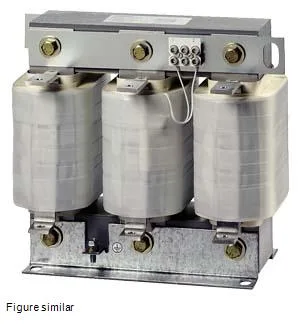
What this mains choke does on a VFD line
It smooths the current drawn from the supply, reduces harmonic distortion, and limits inrush peaks — essential for protecting the drive's rectifier and extending DC-link capacitor life. Rated 531 A continuous with a 590 A maximum, it sits upstream of a VFD feeding a large motor load, typically a pump, fan, or conveyor on a 400 V AC, 50 Hz line. At 40 °C ambient, the thermal class H insulation (200 °C continuous rating) gives headroom for sustained full-load operation inside a warm cabinet.
The choke measures 0.46 m wide by 0.435 m high by 0.265 m deep — a substantial unit that requires dedicated panel floor space, not a DIN-rail clip. Main circuit connections use flat-type terminals (bus-bar or cable lug), typical for high-current line reactors of this class.
The 590 A maximum is the short-term overload ceiling — useful for motor starting inrush or temporary overload conditions. A 6 % voltage drop at rated current is the industry-typical impedance for VFD input reactors; it provides enough harmonic mitigation to meet IEEE 519 guidelines without dropping excessive voltage across the choke under full load.