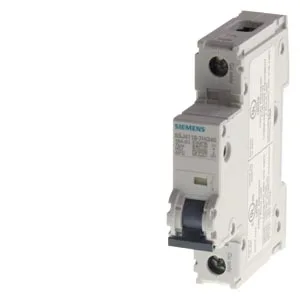
The C tripping characteristic handles moderate inrush currents from motor starters or contactor coils, while the 10 kA breaking capacity per EN 60898 (15 kA per IEC 60947-2) covers most industrial fault levels up to 400 V AC.
Rated at 400 V AC (60 V DC), this MCB is suited for single-phase branch circuits in 400/230 V distribution boards. The 10 kA rating per EN 60898 is the standard for residential and light-commercial panels; the 15 kA per IEC 60947-2 applies when the breaker is used in industrial applications where higher prospective fault currents are expected — the higher figure is what governs in a factory-floor sub-distribution board. For purely resistive loads or long cable runs, a B-curve would trip faster; for high-inrush transformers, a D-curve is the better call. This one splits the difference for typical mixed loads in a machine panel. With an insulation voltage (Ui) of 440 V AC and overvoltage category III, the breaker is rated for fixed-installation distribution boards where transient overvoltages from the grid are expected. Mounting position is unrestricted, and the supply can come from either end — no top/bottom orientation rules to remember during wiring.
Halogen-free and silicon-free construction matters in clean-room or semiconductor-adjacent installations where outgassing can contaminate optics or contacts. The breaker also carries IP20 protection (finger-safe with connected conductors) and IP40 in the handle area, so it's fine for enclosed panels but not for washdown zones.