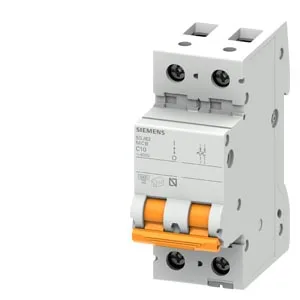
The 5SJ6150-6: The 50 A rating on a 1-pole footprint handles a 50 A resistive or lighting load on a 240 V AC single-phase circuit. The B-curve's 3–5x In trip window (150–250 A magnetic release) keeps it from dropping out on the small inrush of tungsten lamps or heating elements, but it's not meant for motor starting — that's C or D curve territory. The 6 kA breaking capacity (both EN 60898 and IEC 60947-2) tells you it can safely clear a hard short up to 6,000 A without welding its contacts or rupturing. The 60 V DC maximum rating means it can also serve a DC branch circuit up to that voltage, though the DC breaking performance is lower than the AC figure — don't assume 6 kA on DC.
This breaker occupies 1 width unit (roughly 18 mm) on a DIN rail — standard 35 mm top-hat rail. The installation depth is 70 mm, which fits most enclosure backplates without crowding. It accepts solid or stranded conductors from 0.75 mm² up to 25 mm², so it can terminate anything from a 1.5 mm² lighting circuit to a 16 mm² feeder. The terminals are sealable for panel-lockout or tamper-evident tagging. Mounting position is any, which helps when the panel layout is tight.
Halogen-free and silicon-free construction — useful in clean rooms or where outgassing could contaminate optics or contacts. Ambient temperature range is -20 to +45 °C, with periodic excursions to +55 °C and up to 95% humidity. Storage range is wider: -40 to +75 °C. The insulation voltage is rated 440 V AC, and overvoltage category 3 means it's designed for fixed-installation distribution boards, not for surge-prone outdoor drops. Vibration resistance per IEC 60068-2-6 is 50 m/s² at 25–150 Hz and 60 m/s² at 10–150 Hz — enough for industrial panel vibration but not for direct machine mounting without additional damping. Mechanical service life is 20,000 switching cycles typical.