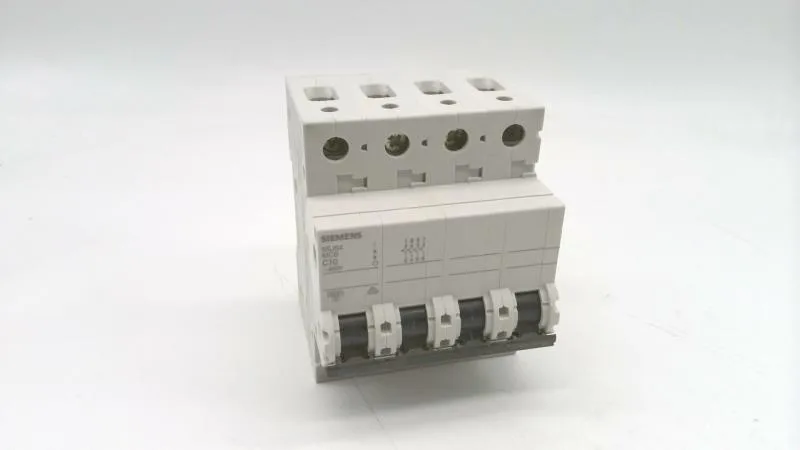
What this 4-pole B-curve MCB delivers
Don't use it for motor starting; that needs a C or D curve to ride through the inrush. If your panel's SCCR study shows higher fault levels, step up to a 10 kA or 15 kA rated MCB. Rated insulation voltage is 440 V AC, and the maximum operating voltage in multi-phase operation is 440 V AC. The DC side is rated to 60 V maximum, so it can handle some DC control circuits, but not higher-voltage DC bus work.
Panel fit and wiring constraints
This 4-pole unit occupies 4 width units (about 72 mm) on a standard DIN rail. The 70 mm installation depth fits most enclosure depths; check your gland plate clearance if the panel is shallow. Mounting position is any — horizontal, vertical, upside down — so it's flexible for tight layouts. That's a wide range — fine for 1.5 mm² control wiring and heavy enough for 6 mm² or 10 mm² feeder tails. The terminals are sealable, which matters for panel builders who need to lock out adjustment after commissioning. Touch protection is built in (IP20 with conductors connected), so accidental contact with live parts is prevented when the cover is on.
That's standard for an MCB of this class — it's a protection device, not a contactor for frequent switching. Vibration resistance is tested to IEC 60068-2-6 at 50 m/s² from 25 to 150 Hz and 60 m/s² from 10 to 150 Hz, so it holds up in industrial environments with moderate vibration.
This part carries the SENTRON brand from Siemens, designed as a miniature circuit breaker per the 5SJ6 design. It's classified as energy limiting class 3 and overvoltage category 3, which means it's suitable for fixed-installation distribution boards in building and industrial power systems. The 50 Hz rating is standard for European and most Asian grids; for 60 Hz systems verify the manufacturer's derating guidance, though the 400 V AC rating typically holds.