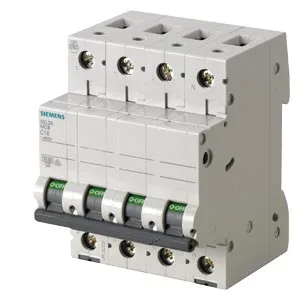
It is designed for overcurrent and short-circuit protection in residential and infrastructure installations, with a breaking capacity of 4.5 kA according to EN 60898 and 5 kA per IEC 60947-2.
At 32 A and 400 V AC three-phase, this 4-pole unit handles a 3-phase plus neutral circuit, common in distribution boards feeding mixed single-phase and three-phase loads. Breaking capacity of 4.5 kA (EN 60898) and 5 kA (IEC 60947-2) means it can safely interrupt fault currents up to those levels. For installations with higher prospective fault current, the 5SL4363-7 sibling offers 10 kA across both standards — the deciding factor is the supply transformer size and upstream coordination study. Power loss per pole is 3.1 W in hot operating state at rated current — relevant for thermal coordination inside a crowded enclosure where cumulative heat from multiple MCBs must stay within the panel's dissipation budget. Mechanical service life is 20 000 operating cycles typical, double the 10 000 cycles of the 1-pole and 2-pole siblings — a useful margin for frequently switched circuits like lighting contactor bypasses.
The 4-module-width body (72 mm wide, 90 mm high, 76 mm deep) occupies four 18 mm slots in a standard distribution board — plan the rail fill accordingly. Installation depth of 70 mm plus the 76 mm overall depth means the breaker projects about 6 mm past the rail — verify enclosure depth clearance, especially in shallow consumer units. The unit accepts supplementary devices such as auxiliary switches, shunt trips, or undervoltage releases — order those separately.
Halogen-free and silicon-free construction reduces corrosive gas emission in a fire — specified for life-safety circuits and sensitive electronic environments. DC rated value maximum is 72 V — not a primary DC breaker, but usable on 48 V or 60 V control circuits with appropriate derating.