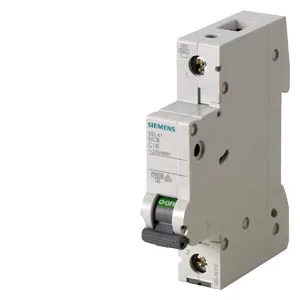
The Z curve is engineered for semiconductor and sensitive electronic loads where the inrush is minimal but short-circuit protection must be fast — it trips between 2.5× and 5× In, so a 16 A unit clears a fault well before a standard B-curve breaker would, protecting downstream rectifiers and power supplies from cascade failure.
The 1-pole width (1 module = 17.8 mm) leaves room for additional poles or auxiliary contacts in the same enclosure. For panel builders, the Z curve means this breaker is not a general-purpose branch protector — reserve it for the supply feed to control transformers, DC power supplies, or variable-frequency drives where the load is predominantly resistive or electronic and the fault current must be interrupted at 10 kA.