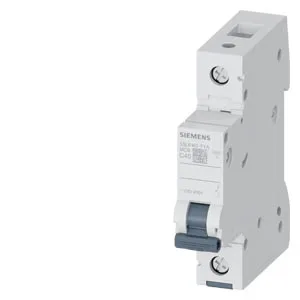
The C curve means it's built for moderate inrush loads: lighting banks, small transformers, and general-purpose socket outlets where the start-up surge is higher than a resistive load but not motor-grade. At 40 A on a single pole, this is a main incomer for a sub-distribution board or a high-current branch circuit.
Snaps onto standard DIN rail — 18 mm width (one modular unit), 90 mm height, 76 mm depth. Terminals accept solid or stranded copper from 0.75 mm² up to 25 mm², tightened to 2.5–3 N·m. That's a wide enough wire range to feed a 40 A circuit with 6 mm² or 10 mm² without adapters. Mounting position is unrestricted, so it fits in vertical or horizontal busbar arrangements. IP20 with the distribution board cover fitted — standard for enclosed panels, not for wet areas.
If your installation has a higher fault level (say 10 kA or 16 kA upstream), you'd need a higher-rated MCB or a current-limiting upstream device — but for most final circuits fed from a 63 A or 100 A main switch, 6 kA is adequate. The 10 000 mechanical switching cycles are the mechanical endurance — electrical life under load will be lower, but for a panel that sees a few operations a week, that's decades of service.