What it is and what the ratings mean
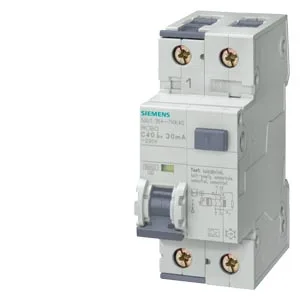
The Siemens 5SU1354-0KV20 is a combined residual-current device (RCD) and miniature circuit breaker (MCB) — an FI/LS-protector — in a single 1+N-pole module. It's rated Type AC (sensitive to sinusoidal AC fault currents only), with a rated residual operating current IΔn of 30 mA, a breaking capacity of 10 kA, and a B-curve trip characteristic at 20 A. The 30 mA sensitivity is the standard threshold for personal protection against direct contact in residential and commercial final circuits; the 10 kA breaking capacity means it can safely interrupt a short-circuit fault up to that level without welding its contacts or cascading failure upstream. The B-curve (3–5× In instantaneous trip) suits resistive or lightly inductive loads like lighting, socket outlets, and small appliances — not motor circuits, where a C or D curve would be needed to avoid nuisance tripping on inrush.
Where it goes in the panel
This FI/LS-protector snaps onto a standard 35 mm DIN rail in a distribution board or sub-distribution panel. The 1+N-pole format (switched phase plus switched neutral) means it occupies a single module width — 70 mm deep, per the description — and the neutral pole opens with the phase, which is required in some regional wiring regulations for RCD-protected circuits. The Type AC designation limits it to sinusoidal AC residual currents; if the downstream load includes electronics with half-wave rectification (e.g., switched-mode power supplies, LED drivers, variable-speed drives), a Type A or Type F device would be needed to detect pulsating DC fault currents that Type AC cannot see.
