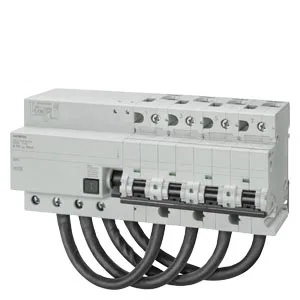
That means it handles universal current-sensitive loads — variable-speed drives, UPS systems, EV chargers — where mixed-frequency fault currents would blind a standard Type A device.
The 100 A rating is at 30 °C; at 40 °C it derates to 92.5 A, at 45 °C to 89 A, at 50 °C to 85 A, at 55 °C to 81 A, and at 60 °C to 77 A. Type B residual current detection covers AC, pulsating DC, smooth DC, and high-frequency fault currents up to 1 kHz. That's the key spec for drives, medical equipment, or any installation with rectifiers downstream — a Type A won't catch smooth DC leakage. For purely resistive or long cable runs, a B-curve would trip faster; for heavy transformer inrush, a D-curve might hold better. This one splits the difference. If your prospective fault current exceeds 10 kA, you'll need a current-limiting upstream breaker or a higher-rated device.
This RCBO snaps onto a DIN rail (11 modular width units, 198 mm wide) and mounts in any position. IP20 with the distribution board installed and conductors connected — it's a panel-interior device, not a weatherproof outdoor unit. Feed from top or bottom; the supply cord position is unrestricted. The super resistant K design indicates enhanced resistance to surge currents and environmental stress — useful in industrial panels with frequent switching transients or higher ambient temperatures.