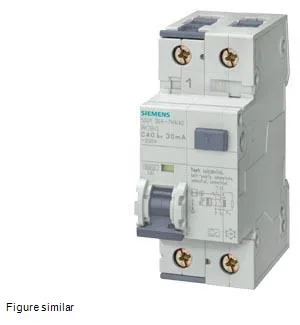
The Siemens 5SU1654-0KK32 is a SENTRON RCBO — a combined overcurrent and residual-current device in a single 2-module-wide (36 mm) package. It protects a 1P+N final circuit at 32 A rated current with B-curve magnetic tripping for short-circuit and overload, plus a 300 mA AC-type residual-current element that disconnects both line and neutral on a ground fault.
Above that, the device derates: 30.4 A at 40 °C, 29.76 A at 45 °C, 28.8 A at 50 °C, 27.84 A at 55 °C, 27.2 A at 60 °C, 25.92 A at 65 °C, and 24.64 A at 70 °C. If the distribution board runs warm — say 50 °C inside the enclosure — the usable load drops to 28.8 A, not the nameplate 32 A. That derating curve is the one that governs real-world sizing, not the 30 °C headline figure. The 300 mA residual-current threshold is a delayed or selective-type trip level — not the 30 mA used for personal shock protection. This RCBO is intended for fire protection or equipment protection on circuits where a lower sensitivity would cause nuisance tripping from leakage in long cable runs or permanently connected equipment. B-curve tripping means the magnetic release operates at 3 to 5 times rated current (96–160 A for this 32 A unit). That suits resistive and general-purpose loads — lighting, socket outlets, small appliances — where inrush is modest. For motor or transformer circuits with higher inrush, a C-curve (5–10× In) would be the correct choice; this B-curve will nuisance-trip on those loads. The 1P+N design switches the line conductor and disconnects the neutral on a residual fault, but the neutral pole is not protected against overcurrent — only the line pole has the thermal-magnetic element. That is standard for single-phase RCBOs in many territories, but worth noting if the local code expects both poles to be switched and protected.
Two modular-width units (36 mm) occupy two adjacent slots in the distribution board. IP20 rated once the distribution board is installed and conductors are connected — meaning finger-safe but not protected against water ingress.