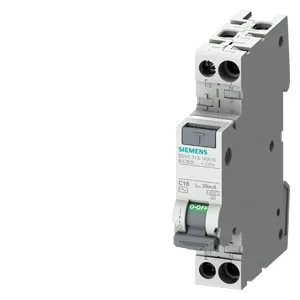
The C-curve means it holds through motor inrush and capacitive loads that would nuisance-trip a B-curve, but trips fast on a hard short — standard choice for general-purpose socket outlets and small equipment feeds.
At 40 °C it derates to 5.64 A, at 50 °C to 5.28 A, and at 70 °C to 4.44 A — so if this lives in a hot panel near a drive or transformer, size the load accordingly. The 300 mA residual current is an AC-type trip (sine-wave faults only), not A-type (pulsating DC) or F-type (mixed-frequency). That matters: if the downstream load includes a VFD, LED driver, or single-phase rectifier that can produce smooth DC fault current, an AC-type RCBO may not trip within the required time. Verify the load's fault signature before committing this to the BOM. The 1P+N design switches the line conductor only; the neutral is switched but not protected against overcurrent. Two physical poles, one with overcurrent protection. That is standard for single-phase final circuits where the neutral is not fused. The 18 mm width (1 modular unit) saves DIN rail space — you can pack 12 of these per 12-module enclosure row.
Mounts in any position on DIN rail. Depth is 77 mm (70 mm installation depth), so it fits standard distribution boards with 80 mm+ internal depth. Halogen-free and silicon-free construction, which matters for panels in high-fire-risk zones (tunnels, data centers) where corrosive gas from a fault must be minimized.