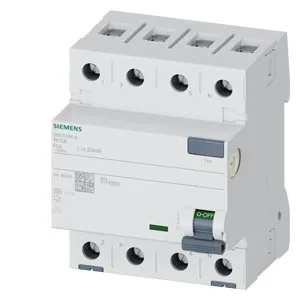
That 30 mA trip is the standard for personnel protection in most IEC-based residential and light commercial panels; Type A means it catches pulsating DC faults on top of sinusoidal AC, which covers modern electronics and single-phase rectified loads. The instantaneous design (no intentional delay) clears fast on a fault, but it also means no selectivity against downstream RCCBs — every device on the same circuit sees the fault at the same time.
Snaps onto standard DIN rail (REG profile). Occupies 4 modular width units — that's 72 mm of rail space, so it eats four 18 mm slots in a typical distribution board. Depth is 70 mm, which matches the standard 70 mm installation depth for this class; the height is 90 mm. Mounting position is unrestricted — horizontal, vertical, upside-down, the trip mechanism works the same. Supply can land on top or bottom terminals; no polarity restriction. IP20 with conductors connected and the board closed — that's the usual for enclosed distribution gear, not for open-panel washdown zones.
Thermal derating — the real-world current
At 45 °C it drops to 77.57 A; at 50 °C to 74.59 A; at 55 °C to 70.22 A; at 60 °C to 64.47 A; at 65 °C to 57.35 A; at 70 °C to 48.8 A.
Fault ratings and coordination
Short-circuit current rating (SCCR) is 10 kA per IEC 61008-1. The let-through energy (I²t) is rated at 110,000 A²·s — that's the energy the device lets pass before it clears. Surge current resistance is 1 kA (8/20 μs waveform), which means it survives lightning-induced or switching surges up to that peak without nuisance tripping.