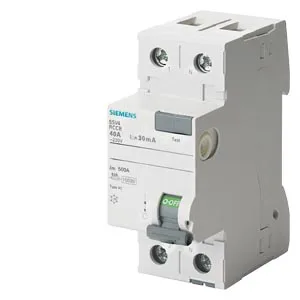
The Type AC designation means it responds only to sinusoidal alternating residual currents; it will not reliably detect pulsating DC or smooth DC faults, so this part stays in AC-only circuits like lighting, socket outlets, and general-purpose power distribution.
The 63 A rating holds flat across ambient temperatures from 40 °C to 55 °C (–), then derates to 56.96 A at 65 °C and 48.2 A at 70 °C (–). That means in a warm panel (say 60 °C internal), you still get the full 63 A; at 70 °C you lose about 23 % of capacity. The breaking capacity per EN 60898 is 0.8 kA, which is the conditional short-circuit withstand when the RCCB is backed by an upstream MCB. For coordination, the 10 kA SCCR is the figure that governs the installation's fault-withstand rating.
Mounting position is any; supply can enter from top or bottom. The IP20 rating applies only when installed in a distribution board with conductors connected — the RCCB itself is not sealed against dust or moisture. Silicon-free construction is noted for applications where outgassing would contaminate sensitive contacts or optics.