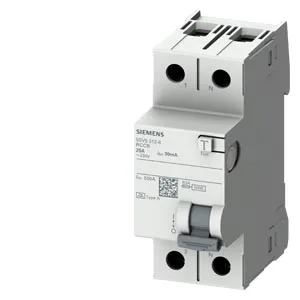
What this RCCB is and where it lands
The Siemens 5SV5614-0 is a 2-pole residual current operated circuit breaker (RCCB) from the SENTRON family, rated 40 A with a 300 mA trip sensitivity, Type AC, for 230 V AC single-phase networks at 50 Hz.
The 300 mA sensitivity is a deliberate choice: it is not a 30 mA personal-protection device. At 300 mA this RCCB is sized for equipment protection or fire-prevention circuits where the leakage path is expected to be higher — think industrial ovens, pumps, or lighting circuits where nuisance tripping on a 30 mA unit would be unacceptable. The Type AC designation means it detects sinusoidal alternating residual currents only; pulsating DC or smooth DC faults (common from variable-speed drives or switched-mode supplies) will not reliably trip this device. If the downstream load includes rectifiers or inverters, a Type A or Type B RCCB would be the correct selection. The 40 A rated current at 230 V AC is the continuous load it can carry in a 45 °C ambient without derating. The thermal dissipation per pole is 1.6 W, so in a multi-device enclosure the cumulative heat load needs to stay within the cabinet's thermal budget. The 6 kA SCCR (per IEC 61008-1) governs the maximum prospective fault current at its installation point — coordinate with the upstream overcurrent device to ensure the available fault current does not exceed that value.
The 70 mm installation depth matches standard SENTRON modular devices, so it aligns flush in a multi-row distribution board. Supply can enter from top or bottom — no mandatory orientation. The IP20 rating applies only when the distribution board cover is fitted and conductors are connected; the device itself is not sealed against dust or moisture ingress. Silicon-free construction is a plus for environments where silicone outgassing can contaminate sensitive contacts or optical surfaces — relevant in semiconductor fab sub-fabs or coating lines.