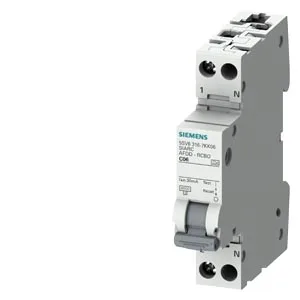
AFDD-RCBO combination for arc-fault and residual-current protection in a single modular width
The Siemens SENTRON 5SV6316-6KP20 integrates an arc-fault detection device (AFDD) with a residual-current circuit breaker (RCBO) in a compact 1-modular-width (18 mm) package. It is a 1P+N, 2-pole unit rated at 230 V AC, 50 Hz, with a B-curve tripping characteristic and a 30 mA type A residual-current sensitivity. This is not a bare MCB; the AFDD section monitors for series and parallel arc faults and will disconnect the circuit before the arc energy reaches a level that could ignite adjacent materials — a requirement now mandated by several national wiring regulations for socket circuits in sleeping-accommodation and care facilities. The unit occupies a single 18 mm DIN-rail module (1 MW). Depth is 68.5 mm, installation depth 70 mm. Height is 90 mm. Mounting position is any.
The B-curve (tripping characteristic class B) means the magnetic trip activates at 3 to 5 times rated current — for a 20 A unit, that is 60 to 100 A. This is the standard curve for resistive and general-purpose loads in residential and office final circuits; it avoids nuisance tripping on inrush from small motors or capacitive loads that a higher-curve unit would ignore. The 30 mA type A residual-current element catches sinusoidal AC faults and pulsating DC faults up to 6 mA smooth DC — covers most modern electronics with half-wave rectification. The 6 kA breaking capacity (Icn) is the short-circuit rating under EN 60898-1 and IEC 60947-2. In a domestic distribution board with a typical upstream 63 A main switch and a prospective short-circuit current (PSCC) under 6 kA at the board, this unit can interrupt a fault without needing a current-limiting upstream MCB. For industrial panels where the PSCC at the final circuit exceeds 6 kA, this part requires an upstream limiting device. In a multi-circuit board with 12 such units, the cumulative heat (42 W) must be considered in the enclosure thermal design; derating above 40 °C ambient is expected though not explicitly tabulated in this evidence.