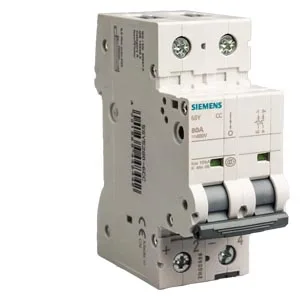
The 10 kA DC breaking capacity at 440 V per IEC 60947-2 means this breaker can safely interrupt a fault up to that level on a DC bus — critical for traction battery banks, converter feeds, or wayside power supplies where AC-only breakers would arc and fail. The operating temperature range of -40 to +70 °C covers unheated equipment compartments and outdoor cabinets across most climates, and the -40 to +75 °C storage range means it can sit in a warehouse or on a shelf without degradation.
Combined terminals at both top and bottom accept solid or stranded conductors from 0.75 to 35 mm², with a tightening torque of 2.5 to 3.5 N·m (22 to 31 lbf·in). The terminal design allows daisy-chaining without separate busbars for some configurations. The breaker is sealable (padlockable handle) and touch-protected per IP20 with conductors connected. Halogen-free and silicon-free construction avoids outgassing issues in sealed railway enclosures or near sensitive electronics. Polarity must be observed on the DC supply side — the breaker is not polarity-agnostic.