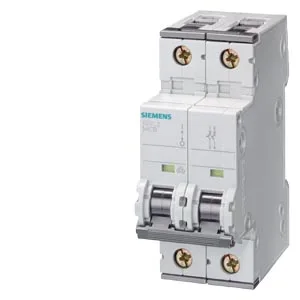
The Siemens SENTRON 5SY5240-7CC is a 2-pole DC miniature circuit breaker rated at 40 A with a C-trip characteristic. It provides 10 kA breaking capacity at 440 V DC per IEC 60947-2, making it suitable for isolating and protecting DC loads in industrial control panels — think DC bus supplies, battery banks, or DC motor drives fed from a rectified AC line.
DC ratings and what they mean for your panel
The 10 kA interrupting rating at 440 V DC (IEC 60947-2) means this breaker can safely clear a fault up to that current and voltage without welding contacts or venting arc plasma. In DC circuits, arc extinction is harder than AC because there is no natural zero-crossing; the 2-pole design switches both lines, doubling the arc gap. This matters for supply-side coordination — if your upstream transformer or battery string can deliver more than 10 kA of prospective fault current, you need a current-limiting upstream device or a breaker with a higher SCCR. The C-curve (magnetic trip between 5× and 10× In) is the standard choice for moderate inrush loads like small DC motors, contactor coils, or capacitive loads. Rated 40 A, it holds the continuous current in a 40 °C ambient without nuisance tripping. The operating voltage maxes out at 500 V DC, so stay at or below that; polarity must be observed on this unit (noted as 'consider polarity' in the specs).
Physical fit and mounting
The 5SY5240-7CC occupies 2 modular width units (36 mm) on a DIN rail, with a depth of 76 mm and an installation depth of 70 mm behind the panel face. That is a standard footprint — drops into any SENTRON or third-party distribution board that accepts 2-MU breakers. The 'quick assembly system' fastening means it snaps onto the rail and can be removed with a screwdriver without disturbing adjacent units. Sealable with a lead seal if the application requires tamper evidence. IP20 with connected conductors means it is protected against finger contact but not against moisture — keep it inside an IP54 or better enclosure if washdown or condensation is present. Pollution degree 3 and overvoltage category III qualification tell you it is rated for fixed industrial installations where transient overvoltages (up to 4 kV phase-to-earth) are expected.
