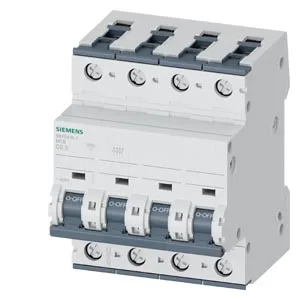
What this 0.3 A 4-pole MCB is for
It protects final circuits in industrial control panels against overload and short-circuit currents, with a breaking capacity of 6 kA per EN 60898 and 30 kA per IEC 60947-2 — the higher figure matters when the breaker sits downstream of a high-capacity transformer where fault current can exceed 10 kA.
Across the three standards listed, this breaker covers the common global specs: 6 kA per EN 60898 for residential and light commercial, 30 kA per IEC 60947-2 for industrial panels where fault levels are higher, 15 kA for DC circuits per the same IEC standard, and 5 kA per UL 1077 for North American supplementary protection. The 30 kA figure gives you selectivity headroom downstream of a larger feeder breaker — you can coordinate so only this pole trips on a fault, not the upstream device. Energy limitation class 3 means it lets through less let-through energy (I²t) than class 2 or 1 breakers, which reduces stress on downstream wiring and connected equipment during a short circuit.
Thermal derating — the real-world current rating
The 0.3 A rating holds at 35 °C ambient. At 45 °C it derates to 0.28 A, at 50 °C to 0.27 A, and at 55 °C to 0.26 A (–). If this breaker lives in a non-ventilated enclosure near transformers or drives, you need to account for that — a 0.26 A continuous load at 55 °C is the actual limit, not the nameplate 0.3 A.