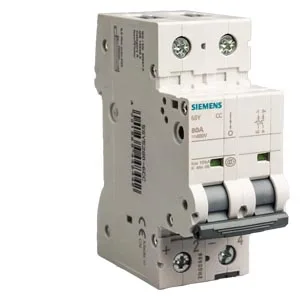
The Siemens 5SY7213-8CC is a SENTRON miniature circuit breaker (MCB) — a 2-pole, 13 A unit with a D tripping curve, rated for 400 V AC and a maximum of 72 V DC. The D curve holds through those surges and clears only on a hard fault. Breaking capacity is 25 kA at 400 V AC per IEC 60947-2, and 5 kA per UL 1077 / CSA C22.2 No. 235 — so it's rated for industrial distribution panels with high available fault current, not just residential load centers. The 2-pole version switches both phase conductors; neutral is not switched (no neutral pole). The 36 mm width (2 width units) fits standard SENTRON enclosures.
The D curve (10–20× In magnetic trip) is the key spec for anyone wiring motor control circuits or industrial power supplies. It's not for general lighting or receptacle loads — those want B or C. Use this where the load has a known high inrush that lasts a few cycles, and you need the breaker to stay closed unless there's a real short. That's enough for most industrial panelboards downstream of a transformer. The 5 kA UL figure is the lower limit for North American listings — still adequate for branch circuits in most UL 508A panels. Mechanical life is 10,000 switching cycles — typical for an MCB used as a disconnect. It's not a contactor; don't cycle it daily under load. Ambient temperature range is -40 °C to 75 °C, with derating above 55 °C (humidity limits apply: 95% at 55 °C, 55% at 70 °C, 35% at 75 °C).