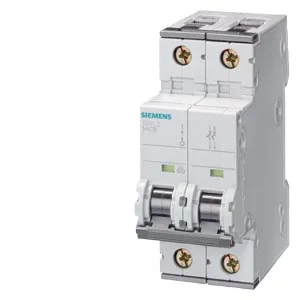
Two poles, no neutral switching, so it lands on a 2-module DIN-rail footprint (36 mm wide, 76 mm deep) and mounts in any orientation. Under UL 1077 it's rated 5 kA, so if the panel ships to a North American site and the spec calls for UL 489 branch-circuit protection, verify the application; this is a supplementary protector per UL 1077.
D curve — what it means for the line
That's the right window for loads that draw a short-duration surge — think a 15 kW motor direct-on-line or a bank of control transformers. The breaker ignores the inrush and only clears on a genuine bolted fault. No thermal element in the trip mechanism (the design is 'only magnetic tripping operation'), so ambient temperature doesn't shift the trip threshold the way it would on a thermal-magnetic. That's useful in a warm cabinet or a panel near a furnace line. The surrounding temperature influence is spelled out: max 95% RH at 55 °C, derating to 55% at 70 °C and 35% at 75 °C.
Mechanical and environmental
Vibration resistance per IEC 60068-2-6: ±1 mm displacement at 5–25 Hz, then 50 m/s² acceleration at 25–150 Hz. That's a standard industrial vibration profile — the breaker holds its contacts and trip calibration under pump or conveyor vibration. IP20 with connected conductors — finger-safe terminals once wired, but the busbar area is open. Sealable (yes), halogen-free, silicon-free. The quick-assembly fastening system is the standard SENTRON DIN-rail clip; no tools needed for mounting or removal.
The breaker accepts add-on auxiliary switches, shunt trips, and alarm contacts via the product extension interface. That means the same physical unit can be specified for a panel that later needs remote trip indication or undervoltage release — the auxiliaries clip on the right side without replacing the breaker.