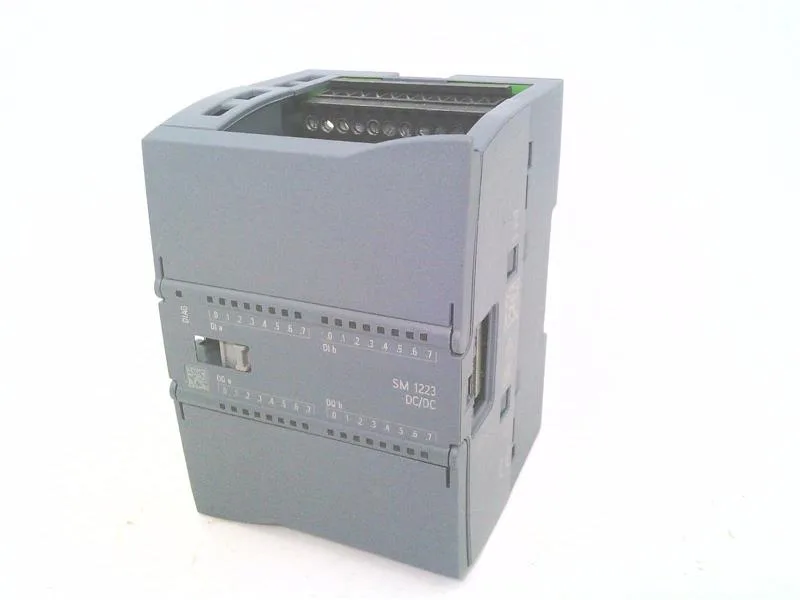
The 6AG1223-1BL32-4XB0: It snaps onto the S7-1200 CPU like any other SM, draws 4.5 W typical, and ships in a 100 mm tall × 70 mm wide × 75 mm deep plastic housing rated IP20 — the front connector is required and ordered separately.
Input side: thresholds, transition, and cable runs
Inputs are 24 V DC, type-1-style thresholds: a '0' is recognised at 5 V DC / 1 mA or below, a '1' from 15 V DC / 2.5 mA up, with 20 V DC / 4 mA as the typical working point. The '0' side is qualified with 0.1 V at a 10 kOhm load, so this module is meant to be driven by a sourcing 24 V signal, not by a dry contact wired directly to the terminal. Worst-case transition times are 50 µs '0' to '1' and 200 µs '1' to '0' — fine for pushbuttons, limit switches, and standard 24 V proximity devices, but worth checking against any high-speed pulse train. Cable runs are derated to 500 m shielded or 150 m unshielded — that ceiling, not the bench length, is what a long-plant layout has to respect.
Output side: per-channel limits and the figure that actually governs the panel
Diagnostic and status bits are present per input and per output, and the module is parameterizable — channel-level diagnostics and a diagnostic alarm ride on the backplane, so a wireman can wire it in and let the programmer decide what gets monitored.
Extended-temperature behaviour and the cold-restart gotcha
Ambient is rated -40 °C to 70 °C, which is the headline number on the SIPLUS line. The 0 °C minimum at cold restart is the quiet detail that matters: a cabinet that is powered up from cold still has to be above freezing before the module will bring its outputs live, even though it will sit at -40 °C once running. Mechanical handling is qualified for a 0.3 m fall height, five times in product packaging — the SIPLUS shipping and drop envelope, not a panel-side handling spec.