What lands in the cabinet
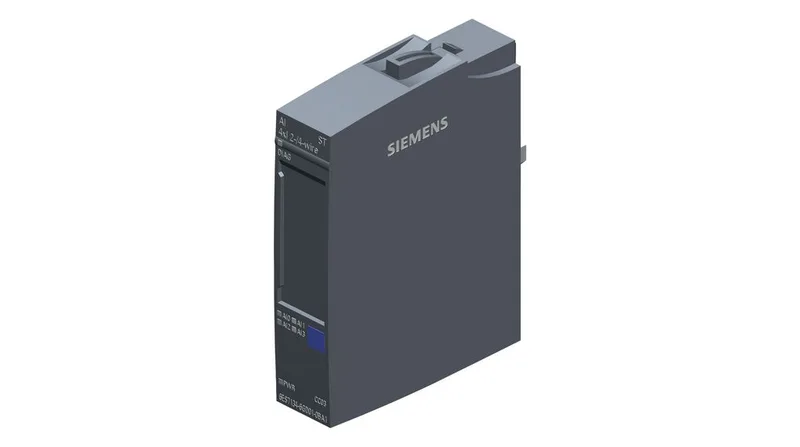
The Siemens 6ES7134-6GD00-0BA1 is an ET 200SP analog input slice — 4 differential inputs dedicated to current measurement, MSI disabled, on the standard 24 V backplane. Current span is fixed: 4 mA to 20 mA, 0 mA to 20 mA, and −20 mA to +20 mA; the 4–20 mA range also carries wire-break detection, and the encoder supply is short-circuit protected in 2-wire mode. Measurement principle is integrating (Sigma-Delta); resolution and speed are governed by that, not by oversampling — the module does not support oversampling or isochronous mode.
Diagnostics, identification and firmware
Diagnostics function is present, with diagnostic alarm and group error; overflow and underflow are reported on the channel group. I&M data is supported from I&M0 to I&M3, the firmware is V1.1, parameters are configurable, and firmware updates are possible in the field — a normal commissioning fingerprint for a current ET 200SP AI. Front-of-card indication is a green channel-status LED plus a green/red module-diagnostics LED; there is no dedicated per-channel diagnostic LED and no voltage-measurement indicator, because the module is current-only.
Power, isolation and field wiring
Rated supply is 24 V DC; typical power dissipation is 0.85 W without encoder supply voltage; the encoder supply can source 20 mA continuous, with a 50 mA per-channel limit for bursts under 10 s. Isolation is type-tested at 707 V DC; channels are isolated channel-group-specific between the 2-wire current input group and the 4-wire voltage input group, which is the wiring option a mixed 2-wire / 4-wire field deployment depends on. Shielded cable run is rated up to 1 000 m; the measuring range is not software-scalable, so any range change is a hardware re-wire against the BaseUnit, not a parameter edit.
Lifecycle stage on record is current. Order against an RFQ; this is not in a last-time-buy window. Pin-compatible alternatives inside the ET 200SP family are typically the matched AI variants on BU type A0 / A1 with different measurement spans (e.g. RTD / TC / voltage siblings); a direct same-span swap is part-number specific and should be confirmed against the family configurator before specifying into a BOM line.