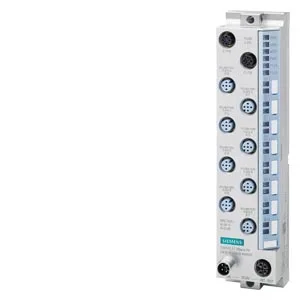
Siemens 6ES7148-6JG00-0BB0 IO-Link Master, 2x M12
Siemens 6ES7148-6JG00-0BB0 IO-Link master communication module, 2x M12 D-coded ports, IRT 250 µs to 4 ms, -40 to 60 °C, 45 x 200 x 48 mm.
Specifications
| Parameter | Value |
|---|---|
| Configurable from STEP 7 TIA Portal version | STEP 7 V17 or higher with HSP 0378 |
| Firmware version | V5.1.x |
| Hardware functional status (FS) | FS01 |
| Parameter | Value |
|---|---|
| Transmission rate, max. | 100 Mbit/s |
| TCP/IP support | Yes; (only EtherNet/IP or Modbus TCP) |
| I&M data support | Yes; I&M0 to I&M3, I&M5 |
| Isochronous mode | No |
| Parameter | Value |
|---|---|
| Rated value (DC) | 24 V |
| Permissible range, upper limit (DC) | 28.8 V |
| Permissible range, lower limit (DC) | 20.4 V |
| Power loss (typ.) | 5.5 W |
| Reverse polarity protection | Yes; against destruction |
| Short-circuit protection | Yes; per channel, electronic |
| Parameter | Value |
|---|---|
| Input data area | 264 byte; + 8 bytes for QI information |
| Output data area | 256 byte |
| Parameter | Value |
|---|---|
| Operating temperature, max. | 60 °C |
| Operating temperature, min. | -40 °C |
| IP protection degree | IP65/67/69K |
| Parameter | Value |
|---|---|
| Width | 45 mm |
| Height | 200 mm |
| Depth | 48 mm |
Product details
Frequently asked questions
Does 6ES7148-6JG00-0BB0 support MRP?
Yes, MRP (Media Redundancy Protocol) is supported, so the module can operate in a PROFINET ring topology and survive a single cable break without communication loss.
Is 6ES7148-6JG00-0BB0 compatible with Siemens S7-1500?
Yes, it is compatible with S7-1500R/H redundant systems and also with S7-400H. It connects via PROFINET through the two M12 D-coded ports.
IO-Link master that survives the nacelle
The Siemens 6ES7148-6JG00-0BB0 is an IO-Link master communication module that brings four IO-Link channels to a PROFINET network through two M12 D-coded ports. It handles IRT cycles from 250 µs to 4 ms in 125 µs frames, which means it can close a control loop on a pitch actuator or a conveyor servo without jitter issues. Rated for -40 °C to 60 °C ambient. The M12 connectors seal against moisture ingress.
Protocols and redundancy for ring topologies
MRP (Media Redundancy Protocol) is supported, so this module can sit in a PROFINET ring and survive a cable break without dropping IO. ARP, LLDP, and SNMP are all on the feature list, which makes network discovery and diagnostics straightforward for a commissioning engineer. It also speaks EtherNet/IP and Modbus TCP, though only one of those three stacks is active at a time. Shared device mode allows two EtherNet/IP scanners to access the same IO data, useful in a dual-controller architecture.
IO and diagnostics that save a service call
The module provides 264 bytes of input data plus 8 bytes for QI (quality information), and 256 bytes of output data. The QI bytes tell you whether each IO-Link channel has a valid device connected — no more guessing if a sensor dropped off the bus. Diagnostic LEDs cover IO, MS (module status), NS (network status), RUN, ERROR, and MAINT. A red-green-yellow IO LED gives per-port status at a glance. I&M data (I&M0 to I&M3, I&M5) is supported for asset management in a Siemens TIA Portal environment.
Port supply and wiring constraints
Port type B provides additional device supply up to 2 A per port, with a module total of 6 A. This matters when you are powering IO-Link actuators or valve islands directly from the module bus — keep the total under 6 A or add an external power supply. The DQ outputs are rated max. 100 mA per channel, so these are signal-level outputs for pilot relays or indicator lamps, not motor contactors. Wire-break detection is included on the inputs.