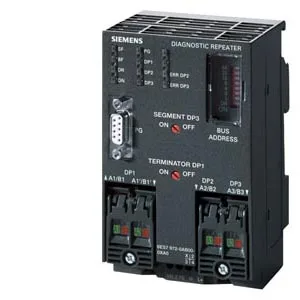
Siemens 6ES7972-0AB01-0XA0 SIMATIC PROFIBUS DP Diagnostic Repeater
Siemens 6ES7972-0AB01-0XA0 — now in phase-out and being discontinued. Supplied from remaining channel stock; full specifications, lifecycle and same-series options are below.
Specifications
| Parameter | Value |
|---|---|
| Max. | 70 °C |
| Min. | -40 °C |
| Depth | 67.5 mm |
| Width | 80 mm |
| Height | 125 mm |
| Operation, max. | 95 %; at 25 °C |
| Weight, approx. | 300 g |
| Power loss, typ. | 4 W |
| Rated value | 24 V |
| IP degree of protection | IP20 |
| Transmission rate, max. | 12 Mbit/s; 9.6 kbit/s to 12 Mbit/s |
| Permissible range, lower limit | 20.4 V |
| Permissible range, upper limit | 28.8 V |
| Design of electrical connection for supply voltage | Terminal module |
| Design of electrical connection for PROFIBUS cables | FastConnect insulation displacement, 10 clamping cycles possible |
Product details
Overview
The 6ES7972-0AB01-0XA0 is a Siemens SIMATIC S7 diagnostic repeater for PROFIBUS DP networks, designed for online diagnostics of the PROFIBUS cable. It operates as a DP standard slave at transmission rates from 9.6 kbit/s up to 12 Mbit/s, with FastConnect connection method and IP20 protection for in-cabinet mounting. This unit draws 4.0 W from a 24 V DC supply, mounts on DIN-rail, and uses screw terminals. It measures 80 x 125 x 67.5 mm (width x height x depth) and weighs 300 g.
The diagnostic repeater sits inline on a PROFIBUS DP segment, regenerating the signal and providing real-time cable diagnostics. It detects and reports physical-layer faults such as short circuits, wire breaks, and missing terminations, which helps a field service tech isolate a failing segment without disconnecting the bus. Transmission rate is configurable from 9.6 kbit/s to 12 Mbit/s, matching the segment's baud rate. The FastConnect method uses standard PROFIBUS connectors with quick-connect terminals, reducing wiring time during commissioning.
Applications
This diagnostic repeater is used on PROFIBUS DP networks in manufacturing lines, process plants, and material-handling systems where cable faults cause intermittent communication drops. It allows maintenance teams to locate and repair cable faults without a bus analyzer, reducing downtime on critical segments.