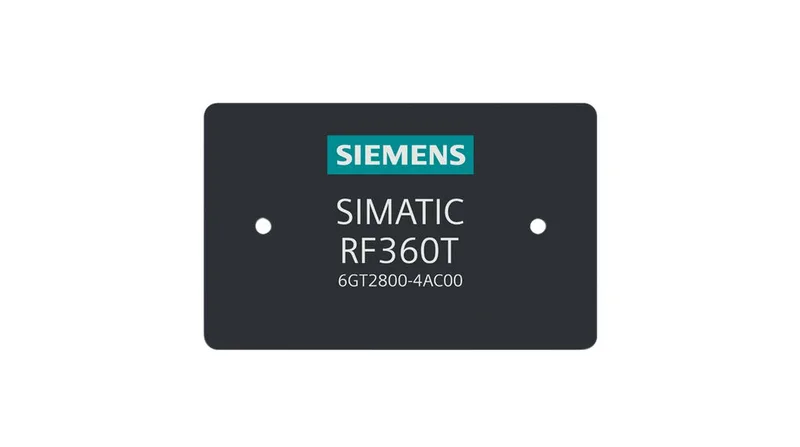
Siemens 6GT2800-4AC00 RF360T Transponder, 8 KB FRAM, IP67
Siemens SIMATIC RF360T EPOXY card transponder, 6GT2800-4AC00, 8 KB FRAM, IP67, 13.56 MHz, 85 x 54 x 2.5 mm.
Specifications
| Parameter | Value |
|---|---|
| Operating frequency (rated) | 13.56 MHz |
| Supported RF protocols | RF300-specific |
| Compatible transponders / systems | RF300 |
| Read/write range, max. | 150 mm; range is reader dependent: observe http://support.automation.siemens.com/WW/view/en/67384964 |
| Air-interface data rate, max. | 106 kbit/s |
| Multitag capable | Yes |
| Parameter | Value |
|---|---|
| User memory capacity | 8189 byte |
| Memory type | FRAM / EEPROM |
| Memory organization | UID (fixed code) 4 bytes, user memory 8189 bytes, OTP memory 20 bytes |
| Memory features (lock / write protection) | Block-by-block write protection of the OTP memory |
| Parameter | Value |
|---|---|
| MTBF | 1200 a |
| Parameter | Value |
|---|---|
| Backup battery included | No |
| Parameter | Value |
|---|---|
| Mounting / fastening method | 2 x M3 screws, mounting bag (see accessories) |
| Width | 55 mm |
| Height | 2.5 mm |
| Depth | 86 mm |
| Material | Epoxy resin |
| Color | anthracite |
| Silicone-free | Yes |
| Printable | No |
| Parameter | Value |
|---|---|
| Degree of protection (IP) | IP67 |
| Temperature, during read/write access | -25 ... +75 °C |
| Temperature, outside read/write area | -40 ... +85 °C |
| Storage temperature range | -40 ... +85 °C |
| Shock acceleration | 500 m/s² |
| Vibration acceleration | 200 m/s² |
| Shock resistance standard | According to DIN EN 60721-3-7 Class 7 M3 |
| Parameter | Value |
|---|---|
| IECEx certified | No |
Product details
Frequently asked questions
Is 6GT2800-4AC00 compatible with Siemens RF300 readers?
Yes, the RF360T is specifically qualified for operation with RF300 read/write devices (suitability for operation: RF300). The read range is reader-dependent — up to 150 mm with the appropriate antenna.
SIMATIC RF360T — 8 KB FRAM Transponder for RF300 Systems
The Siemens 6GT2800-4AC00 is the RF360T EPOXY card transponder in the SIMATIC RF300 family, designed for industrial RFID applications at 13.56 MHz. It provides 8189 bytes of user memory on FRAM/EEPROM with an additional 20 bytes of OTP memory and a 4-byte UID, all in a card format measuring 85 x 54 x 2.5 mm. This transponder is qualified for use with RF300 read/write devices (suitability for operation: RF300) and supports multi-tag reading. The read range reaches up to 150 mm, though the actual distance depends on the specific reader and antenna configuration — refer to the Siemens application note for your reader model.
IP67 Sealing and Environmental Specs
Rated IP67, the epoxy-resin card body withstands dust ingress and temporary immersion — suitable for washdown zones in food-and-bev or pharmaceutical lines where the tag must survive periodic hose-down cleaning. The anthracite-colored housing is silicon-free, a consideration for paint-shop or potting applications where silicone contamination causes adhesion failures. Operating temperature during read/write access is -25 to +75 °C; outside the read/write area and during storage the tag tolerates -40 to +85 °C. Shock resistance per DIN EN 60721-3-7 Class 7 M3 at 500 m/s² and vibrational acceleration of 200 m/s² mean the tag holds data integrity on conveyor lines or machine-mounted applications with regular impact.
Memory Architecture and Write Protection
User memory is organized as 8189 bytes of FRAM/EEPROM, with block-by-block write protection available on the OTP memory region. The maximum transfer rate is 106 kbit/s over the RF300-specific protocol. The transponder has no backup battery and is not printable — data is written and read via the radio link only. Mounting uses two M3 screws with the supplied fixing strap and spacer; continuous torsion or bending stress is not permissible, so the card should be mounted on a flat, rigid surface.
Sourcing and Lifecycle — Active Production
MTBF is listed at 1200 a, reflecting the solid-state FRAM memory with no moving parts or battery. The cULus approval supports installations in North American jurisdictions requiring UL-listed components.