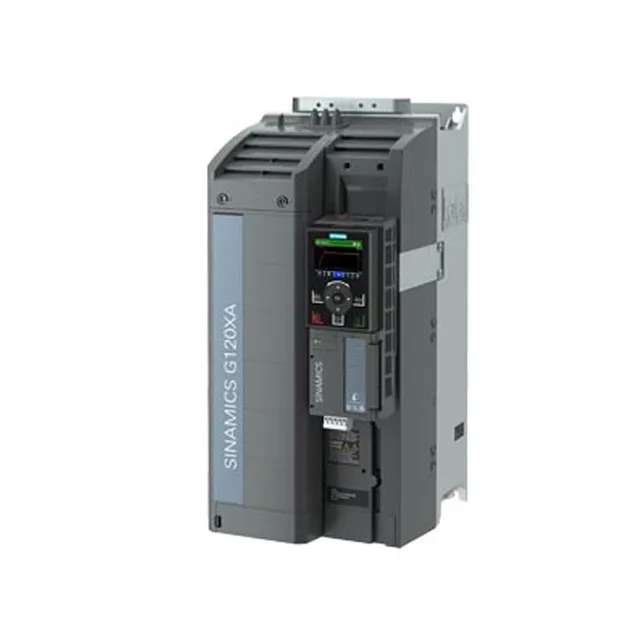
Power and current ratings — what the numbers mean for your motor load
The 6SL3220-2YD44-0UB0: Rated power is 90 kW at 400 V in low overload (LO) duty — this is the continuous rating for a standard pump, fan, or compressor load that does not need the short-term overload headroom of high overload (HO) sizing. Rated current at 400 V (LO) is 164 A, with a maximum output current of 181 A. The input-side rated current at 400 V matches the output at 164 A, so the drive draws what it delivers — no derating surprise on the line side for this duty point. At 380 V input, the rated current steps up to 174 A — the drive pulls slightly more current at the lower end of the voltage window to maintain the same power output. Factor this into your feeder and branch circuit sizing if your plant runs on a 380 V nominal supply.
Input voltage range and frequency — global supply compatibility
Line voltage is 380 to 440 V AC, three-phase, with a +10 % / -20 % tolerance band. That means the drive accepts anything from about 304 V up to 484 V — it handles the saggy utility feeds common in industrial parks without dropping out. No need to order a different variant for a 60 Hz plant versus a 50 Hz one — this single unit works on both.
Output frequency — V/f versus vector control ceiling
For V/f control (simple speed control of standard induction motors), the output frequency goes up to 550 Hz. That is well beyond the 50/60 Hz mains frequency — useful for high-speed spindle or centrifuge applications where the motor runs above base speed. For vector control (sensorless or encoder-based flux-vector control for higher torque accuracy), the output frequency ceiling is 240 Hz. That is the practical limit for most industrial vector drives — the control loop update rate and current regulator bandwidth set this ceiling, not the power stage.
Efficiency and power quality — the 0.98 efficiency figure in context
Efficiency is listed at 0.98 — that is 98 %, which is typical for a modern IGBT-based VFD at full load. The power loss at that operating point is 2.160 kW, so the drive dissipates about 2.2 kW as heat into the enclosure. That matters for panel cooling — a 2.2 kW heat source in a sealed cabinet needs ventilation or an air conditioner, not just convection. Power factor ranges from 0.75 to 0.93, with a displacement power factor (cos phi) of 0.99. The near-unity displacement factor means the drive does not draw reactive current from the line — the input diode bridge keeps the current in phase with the voltage, so you do not need power-factor correction capacitors on the line side.
Physical footprint and installation — 61 kg drive, plan the lift
Sound pressure level is 73.1 dB at 1 meter — about the noise of a vacuum cleaner. In a quiet control room that is noticeable; in a machine hall it blends in. If the drive sits in an office-adjacent space, factor in an enclosure with acoustic damping.