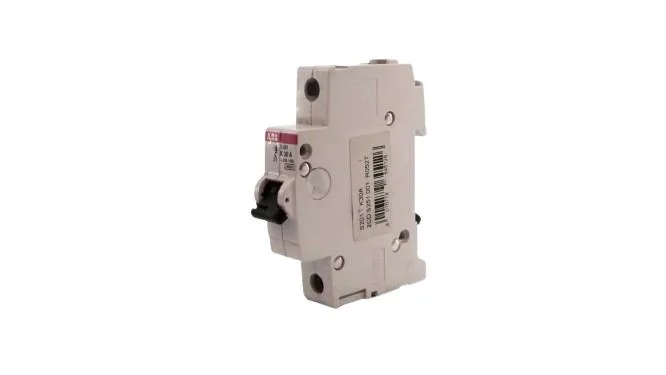
The ABB S201-K30 is a single-pole, 30 A miniature circuit breaker with a K trip curve, rated for 277 V AC and a 6 kA interrupting capacity. It's listed as a supplemental protector under UL 1077 and CSA 22.2, meaning it's intended for branch-circuit protection inside equipment — not as a service entrance or feeder breaker.
DIN rail integration and panel fit
Single-pole width (17.5 mm) means it occupies one module position in a distribution board or control panel. The S200 series uses a captive screw terminal accepting up to 25 mm² conductor — strip length 12 mm, torque 2.0 Nm. No busbar bridging issues with adjacent S200 poles; the pin-and-fork busbar system is shared across the family.
What the K-curve means for your load
The K-curve is the deciding spec for this breaker. It's optimized for inductive loads — motors, transformers, solenoids, and power supplies — where the inrush current can briefly hit 8x to 12x the full-load rating. A standard C-curve (5x to 10x) might trip on the magnetizing inrush of a 30 A transformer; the K-curve's 10x to 14x magnetic trip window gives the headroom to pass that transient. The thermal element handles the 30 A continuous rating.
Approvals and compliance documentation
Listed under UL 1077 (Supplemental Protector) and CSA 22.2 No. 235. The UL 1077 listing means it's recognized for overcurrent protection within equipment — it's not a UL 489 branch-circuit breaker for service entrance use. CE marked for the European low-voltage directive. RoHS and REACH compliant per ABB's standard declaration, available on request with the order documentation package.