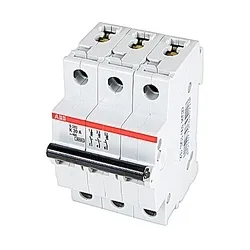
The ABB S203-K30 is a 30 A, 3-pole miniature circuit breaker from the S200 series, with a K trip curve and a 6 kA interrupting rating at 480Y/277 VAC. It snaps onto DIN rail and is listed as a UL 1077 supplemental protector per CSA 22.2 — meaning it protects downstream equipment, not the branch circuit feeder.
K Curve vs. C or D — The Selectivity Call
The K curve sits between C (5–10x In) and D (10–20x In) for magnetic trip threshold. Compared to the S203-C8 (8 A, C curve, 10 kA), the S203-K30 has a higher inrush tolerance and a lower interrupting rating (6 kA vs. 10 kA). Against the S203-D13 (10 A, D curve, 10 kA), the K30 offers three times the continuous current but a tighter magnetic band — it won't ride through the same level of transformer inrush a D curve would.
DIN-Rail Integration — Panel Fit and Spacing
Three-pole width is 3 x 17.5 mm = 52.5 mm. The S200 series uses tunnel terminals accepting up to 25 mm² conductor — strip length 10 mm, torque 2.0 Nm. No side clearance needed for heat dissipation at 30 A, but group derating applies when multiple breakers are ganged without spacing; ABB's derating table for the S200 series at 30 A suggests 0.85 factor for six adjacent units at 40 °C ambient.