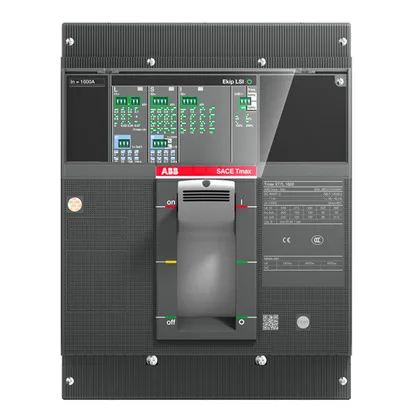
The LSI designation means it provides Long-time, Short-time, and Instantaneous protection — adjustable via the DIP switches on the front face, so you can shape the trip curve to the load without swapping trip units. This is a fixed (non-withdrawable) version with front terminals, UL listed for North American panel builds.
The 1000 A frame is the physical platform — it determines the mounting footprint, busbar spacing, and lug size. The EKIP DIP LSI trip unit is what makes this breaker selectable: L (long-time) sets the thermal pickup for overloads, S (short-time) provides a delayed trip for moderate faults, and I (instantaneous) clears high faults in under a cycle. The DIP-switch adjustability means you commission the protection settings on the panel floor, not at the factory. Three-pole configuration suits three-phase power distribution, motor feeder, or main breaker duty in a UL 489 panel.
Deployment context
This breaker mounts into a standard switchboard or panelboard enclosure — it is not a DIN-rail device. The fixed-mount version is bolted directly to the bus, so plan for a dedicated mounting position and access to the front terminals for cable or busbar connection. The UL listing covers North American installations; the same part carries IEC ratings for global projects. For a 1000 A main or large feeder, factor in the physical space — roughly the width of a 3-pole frame at that rating — and the required clearance for arc-flash boundaries per NFPA 70E.